The story of how memory became a competitive mind sport, how a championship works, and how the sport grew in India
Athletes train their bodies to run faster, jump higher and lift more. Chess players train their minds to calculate and plan.
But until 1991, nobody had turned memory itself into a sport.
That changed in London.
1991: A New Mind Sport Is Born
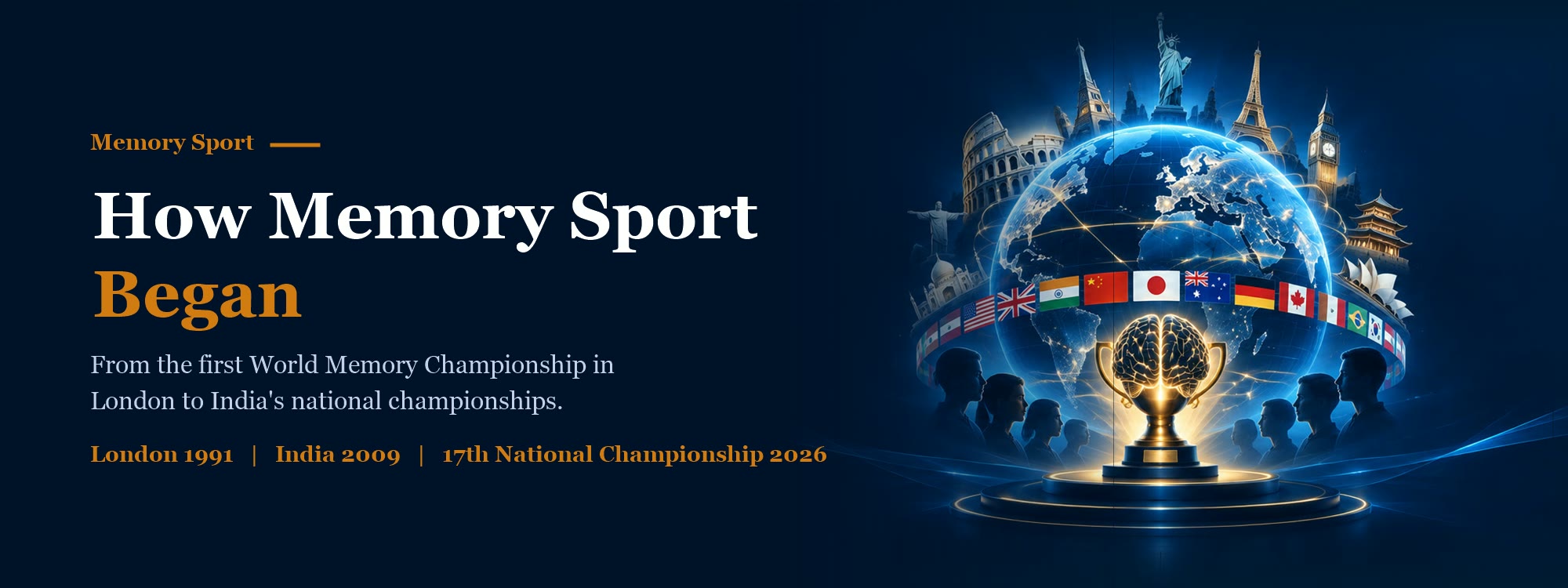
In 1991, Tony Buzan and Raymond Keene established the World Memory Championships and held the first championship in London.
Their idea was simple and bold. Memory would no longer be treated only as a natural ability that some people have and others do not. It would be treated as a skill that can be trained, measured and challenged, just like any other sport.
Competitors were given unfamiliar information, such as numbers, playing cards and words, and a fixed amount of time to memorise it. Then they had to reproduce it as accurately as possible. Every answer could be checked and scored, so performances could be compared fairly.
The first world champion was Dominic O'Brien of the United Kingdom, who went on to win the title eight times.
What Makes It A Sport
Memory Sport follows the same principles as any other competitive sport.
- Clear rules: every discipline has a fixed format and time limit.
- A fair measure: answers are checked and scored, so results are objective.
- Training: athletes practise regularly to improve their speed and accuracy.
- Records: best performances are recorded, and athletes try to beat them.
- Categories: competitors are grouped by age so that everyone competes fairly.
The difference is that the muscles being trained are mental: attention, concentration, visualisation, organisation and recall.
How A Memory Championship Works
Each discipline has two phases.
In the memorisation phase, competitors study the material within a strict time limit: a page of numbers, a shuffled deck of cards, a list of words, a set of faces with names, and so on.
In the recall phase, the material is taken away and competitors write down or arrange what they remember. Their answers are then compared with the original and scored.
Over time, the championship settled on ten standard disciplines, which are still used today, including at the 17th Indian National Open Memory Championship 2026:
- Names & Faces
- Binary Numbers
- Random Numbers
- Abstract Images
- Speed Numbers
- Historic & Future Dates
- Random Playing Cards
- Random Words
- Spoken Numbers
- Speed Cards
Scores across the disciplines are added together to find the overall champion.
The Secret Behind The Performances
When people first watch a memory athlete memorise a shuffled deck of cards in a couple of minutes, they often assume it is a special gift.
It is not. Memory athletes use memory techniques, such as the Memory Palace and number and card systems, that turn information into vivid images and place them along familiar mental routes. The techniques are learned and then sharpened through regular practice.
This is what makes Memory Sport open to everyone. Children, students, adults and senior citizens can all learn the same techniques and compete.
From London To The World
What began in London gradually spread across the world. National championships developed in many countries, and international competitions brought memory athletes from different continents together on one stage.
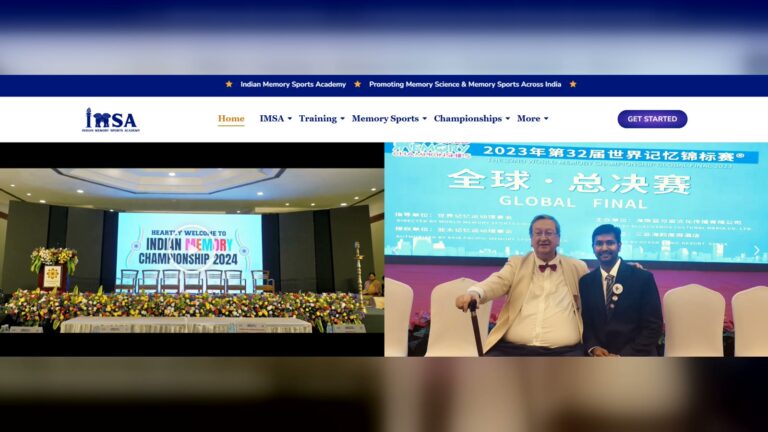
Asia became one of the strongest regions for the sport, with large championships and many top athletes. India has been part of that story: in 2023, an Indian team represented the country at the 32nd World Memory Championship in Sanya, China.
Today, international championships are organised by bodies such as the World Memory Sports Council and the International Association of Memory. In 2025, IMSA student Dhruv Meher Thogarchedu became Junior World Champion at the IAM World Memory Championship in Mumbai.
Memory Sport Comes To India
In India, the sport owes much to Squadron Leader Jayasimha Ravirala, President of the Indian Memory Sports Council, who has promoted Memory Sport in the country for more than two decades.
In 2009, he began conducting the Indian Memory Championships, giving Indian memory athletes a structured platform to train, compete and test their abilities.
The championship has grown steadily since then. The 15th Indian National Open Memory Championship in 2024 brought together 180 participants from 3 countries, 14 states, 60 towns and cities and 74 schools, aged from 7 to 73.
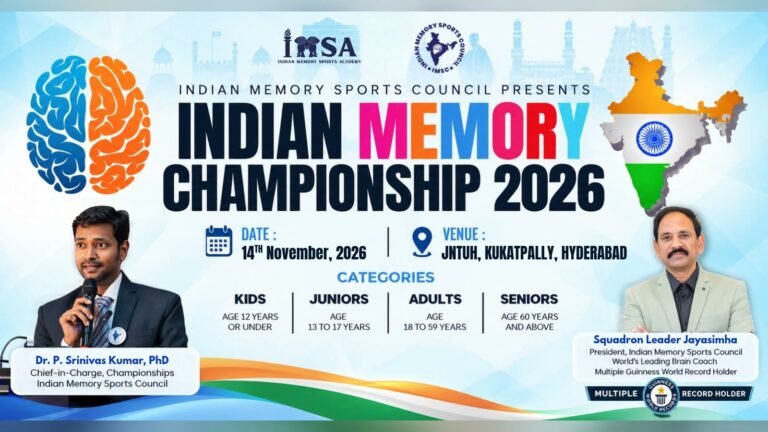
The next chapter is the 17th Indian National Open Memory Championship on 14 November 2026 at JNTUH, Hyderabad.
A Sport For Every Age
One of the most remarkable things about Memory Sport is who can take part. A seven-year-old and a seventy-year-old can compete in the same disciplines, on the same day, under the same rules.
That is why championships have age categories for Kids, Juniors, Adults and Seniors, and why the sport continues to attract families, schools and lifelong learners.
Where Will Memory Sport Go Next?
More than three decades after that first championship in London, Memory Sport has become a global mind sport with athletes, trainers, organisations and championships across the world.
In India, the goal now is to take it to the grassroots, so that every student knows that memory can be trained and has the chance to try the sport if they wish.
Learn more on our About Memory Sports and History of Memory Sports pages, or take the next step and join the 17th Indian National Open Memory Championship 2026.